
TO TOP

Urban Border Spaces

Funded by the German Research Foundation (DFG)
Funding duration: 2018-2023

About | Team Publications


Cities have been recognized as key sites for the inclusion of migrants. What has been less recognized is that the growing diversity of mechanisms of urban migration control is turning cities into key sites for exclusion as well. The project investigates city policies and practices of urban migration control and how they are experienced by migrants, in other words, it analyses the emergence of urban border spaces in Europe.

While studies on migration and border control have been focusing primarily on national and, increasingly, European scales, preliminary research for this project indicates that urban authorities and non-state actors play important roles in this field, through identity checks in city streets, for example, or through the checking of migrants residence status for the provision of social services. To close this research gap, this project draws on and integrates three previously disconnected strands of research, namely, urban migration research, which focuses on urban inclusion and citizenship but has largely neglected the issue of borders; border studies, which reveals the fundamental transformations of border spaces in Europe but does not consider the role of cities; and urban studies, which considers urban transformations but has rarely, if ever, addressed the role of borders. The disconnectedness of these three strands of research has obfuscated the fact that some recent border transformations concern urban migration control, which is intimately related to processes and migrants’ experience of exclusion and inclusion in cities.

In addressing this gap in the research on urban forms of control, this project asks (a) how cities engage with migration control; (b) how migrants experience urban control; and (c) how we can explain differences across cities. It further seeks to understand and conceptualize (d) the relationship between (urban) citizenship and control. These questions are addressed by means of qualitative social science research based on an urban comparative design, with comparison being premised on the assumption that the scalar position of a city in the global urban hierarchy and the degree of global connectivity influence urban politics of control. The research is conducted in Germany and Spain and involves data from official statistics and documents, semi-structured interviews with staff from local authorities and other relevant organizations, and narrative biographical interviews with migrants. Our work in these countries focuses on two global cities, Frankfurt am Main and Madrid, and two less globalized cities, Dortmund and Bilbao.

The project contributes to the empirical and theoretical understanding of cities and urban spaces in the changing spatial organization of borders in Europe, which will help us understand the interconnected dynamics of inclusion and exclusion, of (urban) citizenship and control, and how the interplay of these dynamics shapes the lives of migrants in European cities.


The project was carried out between 2018 and 2023 at Bielefeld University, Darmstadt University of Applied Sciences and Ruhr University Bochum

Prof. Dr. Margit Fauser | Principal Investigator

Elena Fattorelli | Researcher (2020-2023)

Corinna Angela Di Stefano | Researcher (2020-2022)

Katharina Mach | Student Research Assistant (2023)

Deborah Balts | Student Research Assistant (2020-2021)

Sarah von Querfurth | Student Research Assistant (2018-2019)

Nathale Nelo Martins | Student Research Assistant (2018-2019)

Ole Oeltjen | Researcher (2018-2019)


  • Di Stefano, Corinna A., 2025, Unsheltered (im)mobilities and access to healthcare in Frankfurt am Main, in: Luca Follis, Karolina Follis and Nicola Burns (eds.): Migrant and Refugee Access to Health Systems, Cheltenham: Edward Elgar. DOI: 10.4337/9781035324989.00022
  • Di Stefano, Corinna A., 2024, Internal bordering and debordering in urban humanitarian healtch care, Ethnic and Racial Studies 47(12), 2520-2540. DOI: 10.1080/01419870.2024.2344691.
  • Fattorelli, Elena, 2024, Administrative control mechanisms in the descent-based family reunification of refugees, Ethnic and Racial Studies 47(12), 2541-2562. DOI: 10.1080/01419870.2024.2345459.
  • Fauser, Margit (guest ed.), 2024, Mapping the Internal Border, Special Issue of Ethnic and Racial Studies, (47)12.
  • Fauser, Margit, 2024, Mapping the internal border through the city: an in introduction, Ethnic and Racial Studies (47)12, 2477-2498. DOI: 10.1080/01419870.2024.2344693.
  • Fauser, Margit, Corinna A. Di Stefano & Elena Fattorelli, 2023, Multiple Facets of Borderwork. Urban Actors Between Migrants' Struggles and State Control, Journal of Intercultural Studies, 44:1, 61,76, DOI: 10.1080/07256868.2022.2159340
  • Fauser, Margit, 2020, Grenzen aus Papier. Einblicke in die Erforschung lokaler Erfahrungen von Migrant*innen im europäischen Grenzregime, unter Mitarbeit von Nathale Melo Martins und Sarah von Querfurth, in: Migration and Belonging, 02/11/2020, https://belonging.hypotheses.org/2809  [11.11.2020].
  • Fauser, Margit, 2019, The Emergence of Urban Border Spaces in Europe, Journal of Borderlands Studies 34(4), 605-622. DOI: 10.1080/08865655.2017.1402195.
  • Fauser, Margit, Anne Friedrichs & Levke Harders (guest ed.), 2019, Migrations and Border Processes: Politics and practices of belonging and exclusion from the 19th to the 21st century, Special Issue of Journal of Borderlands Studies, Volume 34, Issue 4 [Reprint 2021 London: Routledge]. DOI: 10.4324/9781003141570
  • Fauser,Margit Anne Friedrichs & Levke Harders, 2019, Migrations and Borders: Practices and Politics of Inclusion and Exclusion in Europe from the Nineteenth to the Twenty-first Century, Journal of Borderlands Studies 34(4), 483-488. DOI:10.1080/08865655.2018.1510334

Special Issue: Mapping the internal border

Ethnic and Racial Studies, 2024, 47(12)

This Special Issue showcases the shift of the border from the external line toward diverse sites and actors within the territory of the state and explores how this specifically concerns the city and the urban space. In other words, it offers a mapping of the internal border.

This editorial introduces the concept of the internal border through some key conceptual figures and main themes that provide elements for its theorisation, some of which are further examined by the contributions of this Special Issue.

  • Fauser, Margit, 2024, Mapping the internal border through the city: an in introduction, Ethnic and Racial Studies, (47)12, 2477-2498. DOI: 10.1080/01419870.2024.2344693.
  • Gargiulo, Enrico 2024, Internal status borders: municipal registration between emancipation, exclusion and omission in Italy, 47(12), 2499-2519. DOI: 10.1080/01419870.2024.2344683.
  • Di Stefano, Corinna A., 2024, Internal bordering and debordering in urban humanitarian healtch care, 47(12), 2520-2540. DOI: 10.1080/01419870.2024.2344691.
  • Fattorelli, Elena, 2024, Administrative control mechanisms in the descent-based family reunification of refugees, 47(12), 2541-2562. DOI: 10.1080/01419870.2024.2345459.
  • Bonizzoni, Paola & Iraklis Dimitriadis, 2024, Homeless or refugee? Civil Society Actors and the (un)making of internal borders in an Italian frontier town, 47(12), 2563-2586. DOI: 10.1080/01419870.2024.2345462.
  • Sunata, Ulaş & Feriha Nazda Güngördü, 2024, (Non-state) actors in internal bordering and differential inclusion: Syrian refugees' housing experience in Turkey, 47(12), 2587-2608. DOI: 10.1080/01419870.2024.2344684.
  • Borrelli, Lisa Marie, 2024, Mobile spaces of control and moral geopraphies: places of internal bordering, immorality and crime in Sweden, 47(12), 2609-2630. DOI: 10.1080/01419870.2024.2345463.
  • Lafazani, Olga, 2024, Residing (at) the border: ethnographies of precarious homes and internal borders, 47(12), 2631-2651. DOI: 10.1080/01419870.2024.2344692.
  • Bueno Lacy, Rodrigo & Henk van Houtum, 2024, Europe's spectacular borderlines: on refugee camps, banlieues and other spaces of exception, 47(12), 2652-2674. DOI:10.1080/01419870.2024.2344685.

Special Issue: Migrations and border processes: politics and practices of belonging and exclusion from the 19th to the 21st century
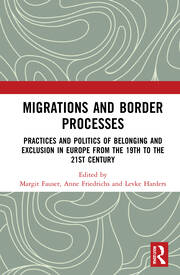
Journal of Borderlands Studies, 2019, 34(4)

Current media images of a “fortress Europe” suggest that migrations and borders are closely connected. This special issue brings together scholars from history, sociology and anthropology to explore cross-border mobility and migration during the formation, development, and transformation of the modern (nation-)state explicating the conflictive and fluctuating character of borders. The historical perspective demonstrates that such bordering processes are not new. However, they have developed new dynamics in different historical phases, from the formation of the modern (nation-)state in the nineteenth century to the creation of the European Union during the second half of the twentieth.

  • Fauser, Margit, Anne Friedrichs & Levke Harders, 2019, Migrations and Borders: Practices and Politics of Inclusion and Exclusion in Europe from the Nineteenth to the Twenty-first Century, 34(4), 483-488. DOI:10.1080/08865655.2018.1510334
  • Genç, Firat, Gerda Heck & Sabine Hess, 2019, The Multilayered Migration Regime in Turkey: Contested Regionalization, Deceleration and Legal Precarization, 34(4), 489-508. DOI: 10.1080/08865655.2017.1344562.
  • BrunsBettina, 2019, Homogenous and Extra-territorial Border Regime? Migrations and Control Efforts Across the Eastern EU External Border, 34(4), 509-526. DOI: 10.1080/08865655.2017.1402194.
  • Schubert, Michael, 2019, The Creation of Illegal Migration in the German Confederation, 34(4), 527-545. DOI: 10.1080/08865655.2017.1402197.
  • Häfner, Lutz Karl, 2019, Engines of Social Change? Peasant Migration and the Transgression of Spatial, Legal and Cultural Divides in Late Imperial Russia, 34(4), 547-570. DOI: 10.1080/08865655.2017.1402196.
  • Harders, Levke, 2019, Belonging, Migration, and Profession in the German-Danish Border Region in the 1830s, 34(4), 571-585. DOI: 10.1080/08865655.2017.1402193.
  • Friedrichs, Anne, 2019, A Site of Shifting Boundaries: Fostering and Limiting Mobility in the Ruhr Valley (1860-1910), 34(4), 587-603. DOI: 10.1080/08865655.2017.1332489.
  • Fauser, Margit, 2019, The Emergence of Urban Border Spaces in Europe, 34(4), 605-622. DOI: 10.1080/08865655.2017.1402195.
  • Fahrmeir, Andreas, 2019, Conclusion: Historical Perspectives on Borderlands, Boundaries and Migration Control, 34(4), 623-631. DOI: 10.1080/08865655.2017.1414625. Reprint:


Reprint:

Fauser, Margit, Anne Friedrichs & Levke Harders (eds), 2021, Migrations and Border Processes: Practices and Politics of Belonging and Exclusion in Europe from the Nineteenth to the Twenty-First Century. London: Routledge.