Many of our activities take place in the RUSTlab. For information please see: https://rustlab.ruhr-uni-bochum.de/

8th October 2026, 13:30-15:20, 4S 2026 in Toronto
Between 7-10 October, the 50th Anniversary for the Annual Meeting of the Society for Social Studies of Science (4S) is going to take place in Toronto. The conference theme is Techno Power • Technoscientific Futures.
As a participant in the panel From Bubbles to Rubbles: Ruins in the Age of AI, Estrid Sørensen is going to present her paper on university data centres, which are at the intersection of planetary burdens and knowledge production, and thus are a key object of study in learning how to operate knowledge machines with the non-extractivistic resources at hand. Their dilemma of demands for more computing energy and the need to save energy is interpreted as a characteristic situation for progress-oriented modern science when standing before ruins. The paper argues that the key challenge to make computing-dependent science response-able to the planet lies in co-enacting scientific knowledge and planetarity.
In addition to participating in the panel, Estrid Sørensen is going to be a discussant in Hannah Rogers’s New Book Panels: Art–Science and Technology Studies, which states that art and science are not as different as often assumed, and therefore asks "What can art and STS do together?“.
More information can be found here.
2nd October 2026, 9:00-11:45, DGS-Congress 2026 in Mainz, Germany
Olga Galanova is going to contribute to the DGS-Congress in Mainz as part of the AdhocGroup "Zu den Quellen – aber wie? Methoden der Historischen Soziologie" with her presentation titled "Zukunft aus der Vergangenheit durchschauen? Zeitperspektiven in Akten zu Rechenzentren". She is going to explore whether and how the history of data centers can be understood by reconstructing the horizons of expectation within which technical infrastructures were once planned, built, operated, and eventually decommissioned. She is going to talk about the multidimensional analysis of historical documentation of data centers, focusing on their content, organizational structures and hierarchies and physical properties, such as handwritten notes or missing attachments.
More information can be found here.
1st October 2026
We warmly welcome the newest member of our team Aljoscha Böhm! He is starting his PhD in the CRC 1567 Virtual Lifeworlds with a strong academic background, having finished a bachelor’s degree in Sociology, Politics & Economics at the Zeppelin University in Friedrichshafen, as well as a master’s degree in Sociology at the London School of Economics and Political Science. Not only did he study at one of the most acclaimed universities in the United Kingdom, but he also did an exchange semester at the University of California. During his PhD he is going to focus on a data center at the Ruhr University Bochum from the 1960s to early 1990s. We are extremely excited about getting to work with him!

1st October 2026, 12:30-14:00, Syracuse University, New York
What does it take for a university to be response-able to the planet? Estrid Sørensen’s ethnographic fieldwork around a scientific data centre shows that the answer is rarely a matter of awareness or good intentions. In fact, a lot of challenges became visible through the ethnographic work that seeks to understand scientific knowledge as planetary, thus as extended relations in and through one shared world. As a guest speaker at Syracuse University in New York, Estrid Sørensen is going to talk about these challenges, as well as the concept of “planetary scientific knowledge”.
More information, including the Zoom link, can be found here.
30th September 2026
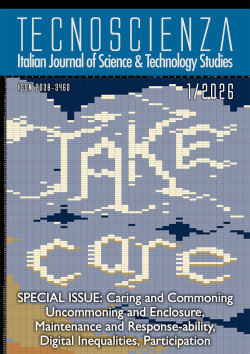
An essay by Mace Ojala titled Maintain-ability: On Life Alongside Computer Software was published in a special issue of the Tecnoscienza – Italian Journal of Science & Technology Studies. The paper addresses the challenges of our co-existence with technology by presenting an empirical study based on interviews conducted with software maintainers, as well as on the notions documented in the Science and Technology Studies’ literature. Mace Ojala suggests a concept of maintain-ability, which describes the programmers’ ability to give and receive care, as well as raises a question of what is necessary for the bodies of software to be able to receive care in the third millennium.
The paper can be found here.
29th October 2026, 14:15-17:00, DGS-Congress 2026 in Mainz, Germany
Zukünfte der Gesellschaft is the theme of the 43rd Congress of the German Sociological Association (DGS), taking place between 28.09. and 02.10. in Mainz. Stefan Laser is going to participate in the Ad-hoc Group Digitale Infrastrukturen und der Kampf um gesellschaftliche Zukünfte, which discusses contested digital infrastructures as struggles over the social and material foundations of society’s future. In this context, he is going to present a paper on the planetarity of data centres. This draws on research in the CRC Virtual Lifeworlds, and new studies on the chip industry.
More information can be found here.

28th September 2026, 15:30-17:00, Cornell University
Estrid Sørensen is going to present at the STS Colloquium taking place at Cornell University with her research on Planetary scientific knowledge and the reality of the contemporary university. The idea of “planetary scientific knowledge”, based on Science & Technology Studies conceptualizes scientific knowledge as inherently planetary, and Estrid Sørensen argues that implementing this approach in modern scientific and university settings is difficult. Based on this premise, she is going to focus on ethnographic studies regarding scientific, data center, and energy management practices at a German university, as well as on various struggles that occur during the realization of planetary scientific knowledge.
More information can be found here.
15th September 2026
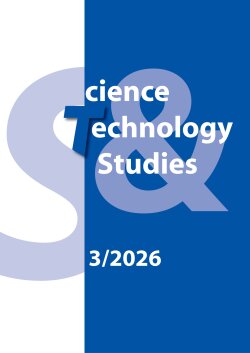
Besides being the editorial team of Across the Layers of Planetary Matter, Data Infrastructures, and Knowledge Production, Estrid Sørensen, Leman Çelik and Stefan Laser have also contributed an article to the special issue, which addresses their already established interest in planetarity. While the traditional view on scientific knowledge within the Science and Technology Studies is that of socio-material character, Estrid Sørensen, Leman Çelik and Stefan Laser are proposing an approach on conceptualising scientific knowledge as extended relations in and through one shared world, or, as the title suggests, planetary. This article therefore emphasizes the necessity of a shift from social to planetary studies of scientific knowledge, motivated by concern over science’s lack of engagement with its role in shaping the planet.
The special issue can be found here.
15th September 2026
Knowledge has planetary weight. It accumulates in infrastructures, flows through cables, and settles in data centres that consume land, water, minerals, and energy on a planetary scale. Yet this weight is rarely felt in the everyday practices through which knowledge is produced, circulated, contested, and consumed. This special issue edited by Leman Çelik, Stefan Laser and Estrid Sørensen offers empirical studies of the interrelations between knowledge, planetary matter, and data infrastructures alongside conceptual discussions of how to think across these layers. The special issue holds an editorial and a theoretical contribution by the authors and furthermore articles by Martin Tremčinský, James Maguire, Anne Pasek, Brian Sutherland, Mads Dahl Gjefsen, Synne Svinsås Gjønnes, Benjamin Sovacool, Can Hankendi, Ayşe Coşkun and Anna-Laila Danielsen, as well as book reviews by Brett Mommersteeg, Nona Schulte-Römer and Aube Richebourg.
The special issue can be found here.
15th September 2026
We warmly welcome Eugene as a new member of our team. He is currently studying social science and mathematics with a particular interest in statistical methods and migration research. We are looking forward to working with him and to the new perspectives he brings through his interdisciplinary background.
10th September 2026, 13:00-13:30, EASST2026 Kraków
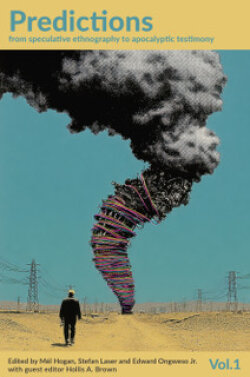
As part of the EASST2026 conference, which is taking place from 7-11 September in Kraków, there is going to be a book launch for the book Predictions: From Speculative Ethnography to Apocalyptic Testimony. Published in June 2026, this is the first of three volumes. Stefan Laser, Mél Hogan and Edward Ongweso Jr., along with guest editor Hollis A. Brown, edited the book, which makes a case for engaging with practices and cultures of predictions. One chapter of a speculative fabulation was contributed by Estrid Sørensen. At the launch, it is possible to talk about the book with some of them over a glass of prosecco or orange juice.
More information ca be found here.
9th September 2026, 9:00-10:30, EASST2026 Kraków
Estrid Sørensen and Olga Galanova are going to take part in the biennial international EASST conference, this year held in Kraków, Poland, in which they are going to organize a panel titled Data infrastructure worldlings: Epistemic and planetary co-enactments. Although not new, the topics of planetary effects of datacenters and epistemic effects of AI are going to be reimagined with an idea of considering both to be connected. The resulting questions regarding worldlings constituted through both planetarity and knowing are going to be discussed through speculative reflections, rather than thinking of them as linear progressions from past to future.
More information about the panel can be found here.
9th September 2026, 9:00-10:30, EASST2026 Kraków
Stefan Laser and Susann Wagenknecht (TU Dresden) are going to organise a panel on Silicon lives: Infrastructures and ecologies of semiconductor industries at the EASST 2026 conference, taking place from 7–11 September. The theme of this year‘s conference is More than now: exploring resilient futures, inspired by the notion of the more-than-human. Against this backdrop, Stefan Laser and Susann Wagenknecht ask about the future of semiconductor industries. What futures can be imagined to change of infrastructures and ecologies of high-tech chip worlds? What makes silicon lives viable and resilient?
More information about the panel can be found here.
1st September 2026
Nicole Zaunith has joined the CRC 1567 Virtual Lifeworlds as a PhD student with a main research focus on a Stasi data center in Wuhlheide, Berlin from the 1960s to early 1990s. Her academic milestones include a bachelor’s degree in Museology and History at the University of Würzburg and a master’s degree in Empirical Culture Science and European ethnology at the LMU Munich. Furthermore, she brings experience as a scientific trainee at the Technoseum in Mannheim. We warmly welcome her to the team and are looking forward to our cooperation!
31st August 2026, 12:00-13:30, Cologne Game Lab at TH Köln
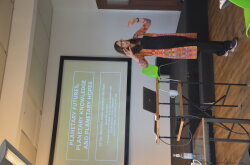
As part of the STRATEGIES Summer School: Planetary Futures of the Cologne Game Lab, Estrid Sørensen is going to give the opening keynote on Planetary futures, planetary knowledges, planetary hopes. The Summer School‘s aim is to translate evidence of environmental topics into action and to find solutions for planetary futures. The two main areas of focus are ecological games and responsible development. In Estrid Sørensen‘s opening keynote, she is going to talk about the notion of the planetary in the social sciences and humanities, which encourages a perspetive in modern culture to think differently, shape different beings, ontologies, care and knowledge. This shift challenges us to imagining futures as planetary and design futures that are planetary.
More information can be found here.
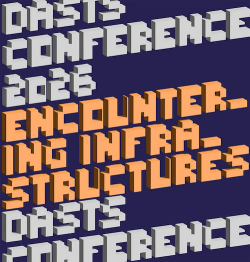
30th June 2026, 15:15-17:00, Aalborg University, Copenhagen
Fabian Pittroff is going to present the paper "Infrastructuring Contingency: Praxiography of Humanities Research Data Infrastructures" at the DASTS conference in Copenhagen on 30 June 2026, in the panel "The Interpretive Layer: Expertise as Infrastructure in Sociotechnical Systems". Drawing on multi-year fieldwork at a humanities research center, the paper addresses the mismatch between the research data infrastructures now consolidating in Germany and open-ended, interpretive humanities research. While data policies ask for systematic and stable data use, the fieldwork documents many everyday, often personal data practices. Fabian Pittroff proposes a broader understanding of data and reported on an attempt to realign an infrastructural ecology by embracing contingency.
More information can be found here.
June 2026
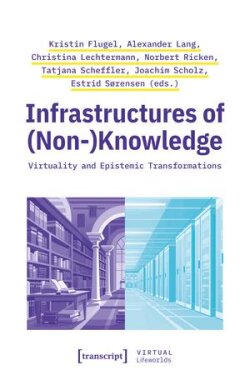
Estrid Sørensen has participated in a chapter of the book Infrastructures of (Non-)Knowledge: Virtuality and Epistemic Transformations. Together with Patrizia Breil, Anne Dippel, Christoph Engemann and Iris van der Tuin - the panelists from the panel Virtual University at the annual conference Infrastructures of (Non-)Knowledge of the CRC 1567 Virtual Lifeworlds on 10 October 2024 – they co-authored the chapter about The Virtual University, in which they discuss the post-Covid shift towards the virtual university. Some questions they speculate answers about are: How do sciences work (together) in the virtual university of the future? How are its infrastructures and its architectures designed? How do we study, research and administer at and through virtual universities? And what does the virtual university make humans feel like?
The book can be found here.
June 2026
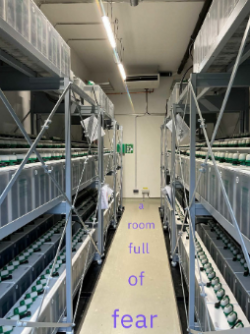
Sandra Abels, Mace Ojala and Estrid Sørensen, along with Jens Fehrenbacher, have contributed a chapter to the new book in the Virtual Lifeworlds book series Infrastructures of (Non-)Knowledge: Virtuality and Epistemic Transformations. In their text, How to Know a Data Centre without Leaving your Cosmology at the Door? An Augmented Reality Field Study, they ask: How can you know a data centre? How can you care? Especially, if you are not a specialist and do not have permission to access one in person. Although, most people do not know or notice data centres, it is necessary to remember the materiality of cloud-technologies and the planetary relations of data centres. This is why the text examines the development and possibilities of an augmented reality data centre experience.
The book can be found here.
June 2026
A new book in the Virtual Lifeworlds book series was published at the end of June, with Estrid Sørensen as one of the editors. As the title suggests, Infrastructures of (Non-)Knowledge: Virtuality and Epistemic Transformations deals with questions of how infrastructures and practices shape what counts as (non-)knowledge in the context of AI-driven infrastructural transformations and digitization of epistemic cultures. The interdisciplinary contributions to this volume offer a broad and nuanced insight into the interrelations between knowledge practices and their infrastructures, including libraries, Wikipedia, human bodies, digital corpora, and universities. Together, they foreground the complexity of knowledge, and invite readers to critically reconsider prevailing epistemic regimes.
The book can be found here.
June 2026
Estrid Sørensen contributed a speculative fabulation to the newly published book Predictions: From Speculative Ethnography to Apocalyptic Testimony (Vol. 1). Her text is one of many predictions in the book, which collects predictions to explore how they can be handled in critical social sciences and humanities disciplines, especially through an STS lens. Predictions not only imagine and anticipate futures, they also show the thoughts, fears and predicaments that we currently face. The subject of the speculative fabulation written by Estrid Sørensen is the future of servers. Although all characters are fictional, the scenes and conversations are inspired by her ethnographic research on data centres in Germany.
The book and more information can be found here.
June 2026
Stefan Laser, along with Mél Hogan and Edward Ongweso Jr., edited the new published book Predictions: From Speculative Ethnography to Apocalyptic Testimony. The book, which is the first volume out of three, makes a case for engaging with practices and cultures of prediction. With a collection of raw, unhinged, despairing, yet also critical and playful predictions the editors wants to generate a conversation as well as a sense of community. Furthermore, this collection serves as an example of how prediction can be handled in critical social sciences and humanities disciplines, especially through an STS lens.
The book and more information can be found here.
June 2026
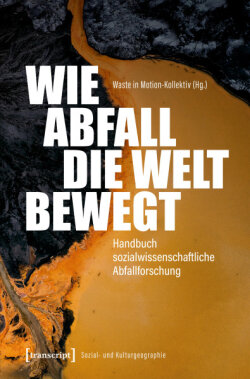
The Waste in Motion-Kollektiv, of which Stefan Laser is a part, has been published a book about social science research into waste as part of our environment. Throughout the book, the main question explored is how waste shapes the world through its relationship with living beings, objects, places and times. Ultimately, the book shows that the question of where, how, when and for whom waste becomes a challenge can only be answered on a case-by-case basis.
The Waste in Motion-Kollektiv is an interdisciplinary research collective, which emerged from the research network "Abfall in Bewegung. Mobilisierungen von Abfällen und Schadstoffen als soziomaterielle Konfiguration“, funded by the DFG since 2022.
The book and more information can be found here.

10th June 2026, 14:30-15:45, Malmö University
The 2026 Swedish STS conference will take place from June, 10th-12th. On June 10th, Estrid Sørensen and Brit Winthereik will talk about "Data centres as traps“, as part of the session "Algorithms, governance & public institutions“, chaired by Elizabeth Fox Jensen. Among other places, Microsoft currently builds datacentres in Zealand and in Western Jutland of Denmark as well as in the Rheinisches Revier in Germany. The lecture will examine the specific arrangements, conditions and captures at both locations. Building on Corsín Jiménez’s thinking of infrastructures as traps with inherent instabilities, the talk will address the vulnerabilities of big tech and ask about the work of data centres in local landscapes and communities.
More information about the conference and the talk can be found here.
9th June 2026, 17:00-18:30, University Konstanz
As part of the event series Forschungskolloquien Allgemeine Soziologie, in which contributions to sociological theory are discussed on the basis of guest lectures and recent publications, Olga Galanova will give a talk on the communication structures of secrecy and indexicality in Stasi telephone calls. The talk will take place at the Unversity of Konstanz‘s department of sociology.
More information can be found here.
8th June 2026, 16:00-18:00, Zoom
Estrid Sørensen is taking part in the DGEKW lecture series on AI in empirical cultural studies, european ethnology and cultural anthropology, titled Künstliche Intelligenz – Expertisen, Anwendungen und Kritik einer „Schlüsseltechnologie“ in der Empirischen Kulturwissenschaft, Europäischen Ethnologie und Kulturanthropologie. Alongside Moritz Altenried, Estrid Sørensen will give a lecture on ethnographic perspectives on the production and the planetarity of AI. The lecture will address topics such as the extractive dimensions, e.g. of micro chips, data centres and AI training, as well as the use of AI in science. In the end, there will be a discussion. The lecture will be hosted by Katrin Amelang.
More information about the lecture series, including the Zoom link, can be found here.
June 2026
Based on his research in the CRC 1567, Stefan Laser has published an article in the Journal of Cultural Economy: “Encountering the semiconductor industry: fairs and global value chains in motion, from Taiwan to Vietnam.” This article examines how industry events shape markets through a comparison of semiconductor fairs held in 2023 on the outskirts of Taipei and Hanoi. The article draws on ethnographic fieldwork to analyze these industry fairs. While Taiwan’s long-established industry offers a choreographed vision, Vietnam’s event reveals an aspirational configuration, shaped by infrastructural gaps and shifting policy frameworks. While this distinction has emerged, it also may quickly collapse on the fair floor in the form of uncertainty. This, in turn, helps understand the extended planetary relations of data centre configurations, which is the main theme of our sub-project A02 in the CRC Virtual Lifeworlds.
The article can be found here.
Studierende, die ihre Masterarbeit zum Themenkomplex "Faktizität" schreiben möchten, haben jetzt die Möglichkeit sich für das Sylff Master-PreDoc-Kolleg zu bewerben und eine Förderung von 750 US-$ monatlich zu erhalten. Estrid Sørensen betreut Themen im Bereich der STS: https://www.research-school.rub.de/about/sylff-master-predoc-kolleg/sylff-master-predoc-kolleg-themenfelder. Interessierte finden alle weitere Informationen und den Link zum Bewerbungsformular auf dieser Seite: https://www.research-school.rub.de/about/sylff-master-predoc-kolleg. Bewerbungsfrist: 9. Juni
Es ist bekannt, dass Rechenzentren sehr viel Energie verbrauchen und von Metallen aus toxischem Bergbau abhängig sind. Weniger diskutiert wird die Frage, ob das Wissen, das durch Rechenzentren produziert wird, diese planetaren Eingriffe rechtfertigt. Das auf den Science & Technology Studies basierende Forschungsprojekt geht auf die Zeit des ersten Rechenzentrumsausbaus zurück und rekonstruiert, wie die Verbindung von Wissen und Planetarität in den 1950er bis 1990er Jahren des ersten Rechenzentrumsausbaus reflektiert und praktiziert wurde – oder was sie verhinderte. Die beiden Doktorand:innen (m/w/d) sollen jeweils eine historische Praxeographie entweder des Stasi-Rechenzentrums in Berlin-Wuhlheide oder der frühen Rechenanlagen der Ruhr-Universität Bochum durchführen. Mithilfe von Archivmaterial und Zeitzeugeninterviews werden die „Worldings” des Rechenzentrumausbaus und ihre Ausstattung mit Wissen und planetaren Elementen rekonstruiert. Durch spekulative Verfahren werden Bezüge zu aktuellen und künftigen Worldings hergestellt.
Weitere Informationen können in der Stellenausschreibung gefunden werden.
6th May 2026, 13:30-15:00, Graz
Fabian Pittroff is organizing a session at the STS Conference Graz 2026 (4–6 May) titled "Data multiple: An inquiry into methodologies and ontologies of data." A decade after the emergence of critical data studies, and with LLMs as the latest chapter in the story of data-making, the session asks how the multiplicity of data can be studied — conceptually and empirically. Drawing on Mol's notion of the "more than one but less than many" and new materialist informatics, it invites contributions on everyday, small-scale, qualitative, non-digital, sensing, and more-than-human data practices, including research data management. Scientific, artistic, and activist perspectives are equally welcome. Pittroff plans to facilitate an online exchange among contributors ahead of the conference, so that the session becomes a continuation rather than a first meeting.
More information, including the full program and the registration, can be found here.
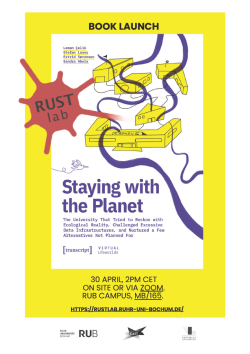
30th April 2026, 14:00-16:00, RUSTlab (MB 4/165) at Ruhr-University Bochum
In February, the new book Staying with the Planet. The University That Tried to Reckon with Ecological Reality, Challenged Excessive Data Infrastructures, and Nurtured a Few Alternatives Not Planned For, written by Leman Çelik, Stefan Laser, Estrid Sørensen and Sandra Abels, was released. The authors are inviting anyone interested to a book launch at the RUSTlab on 30th April 2026.
More information can be found here. Everyone is most welcome!
April-September 2026
Estrid Sørensen was awarded a Fellowship at the Käte Hamburger Kolleg "Cultures of Computing" at the RWTH Aachen from April to September 2026. She will be studying scientific data centres, and particularly their cultures of high-performance computing (HPC). Digitalisation – and particularly HPC – is currently responsible for the highest increase in energy consumption, among others due to increase in artificial intelligence use. This is the case in private and corporate contexts, as it is the case in science. The project inquires how cultures of scientific HPC handle and are influenced by the paradox of the dual need for increased HPC in science and for reduction of energy consumption.
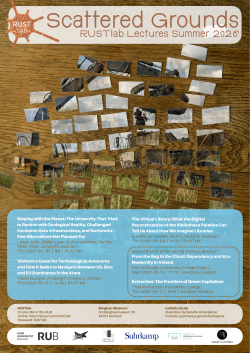
Summer Term 2026, MB 4/165 at Ruhr-University Bochum or Mining Museum Bochum and on Zoom
The programme for the 15th round of the RUSTlab Lecture series is now available. The lectures will take place on site in MB 4/165 and online via Zoom. Exceptions to this are the special events at the Mining Museum. This semester's guiding theme is "Scattered Grounds" and speakers include Leman Çelik, Stefan Laser, Estrid Sørensen and Sandra Abels (Ruhr University Bochum), Tobias Burgers (Fulbright University Vietnam), Suzette van Haaren (Ruhr University Bochum), Patrick Brodie (University College Dublin) and Thea Riofrancos (Providence College).
Please find more information here. Everyone is most welcome!
Find previous news in the archive.
Copyright © SoWi 2026
Last update: Oct 06, 2026